‘We should be prepared to fight high-intensity conflicts’: CDS warns of evolving threats; cites terror, land disputes | India News
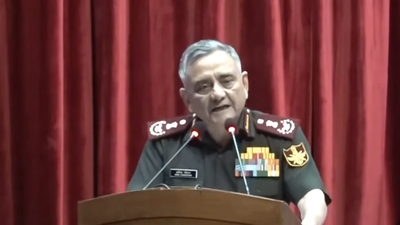
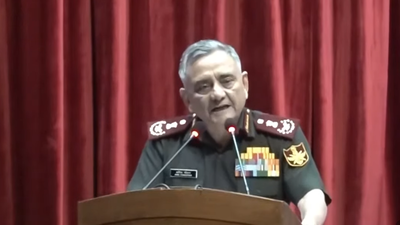
NEW DELHI: Chief of defence staff General Anil Chauhan said on Monday that India must be prepared to fight both short duration, high intensity conflicts to deter terrorism and long duration wars due to territorial disputes with its neighbours. Speaking at the Indian Institute of Technology Bombay, Gen Chauhan said the country faces a complex security environment and must be ready for conflicts across the spectrum. “We should be prepared to fight short duration, high intensity conflicts to deter terrorism, something like Operation Sindoor. We should be prepared for a land centric, long duration conflict because we have land disputes. Yet, we should try and avoid it,” he said.
Without naming Pakistan or China, the CDS said India’s two adversaries include one nuclear weapon state and one nuclear armed state, and deterrence thresholds must not be allowed to break. “What kind of threats and challenges should India be prepared for? This should be based on two facts. Both our adversaries — one is a nuclear weapon state and one is a nuclear armed state — hence we should not allow that level of deterrence to be breached,” he said.Gen Chauhan stressed that multi domain operations would no longer remain an option but a necessity, as actions in one domain would have immediate effects on others. “This was clearly visible in Operation Sindoor. In a war which lasted only about four days giving India decisive victory, all domains of warfare were used simultaneously with great amount of tempo,” he said.The CDS noted that terrorism and grey zone warfare would continue to pose challenges, requiring both defensive and offensive responses. He also underlined the need to exploit new domains to create asymmetry against weaker adversaries while ensuring such asymmetries are not exploited by others.Describing modern warfare as being on the cusp of a third revolution in military affairs, Gen Chauhan termed it convergence warfare, driven by the simultaneous impact of multiple technologies. He cited artificial intelligence, quantum technologies, edge computing, hypersonic systems, advanced materials and robotics as factors reshaping the nature and character of war.He said effective multi domain operations would require corresponding capabilities and cross domain command and control, along with extensive coordination among the Army, Navy and Air Force, as well as cyber, space and cognitive domain forces.India launched Operation Sindoor on May 7 in response to the terror attack in Pahalgam on April 22 that killed 26 people. The operation targeted terror infrastructure in Pakistan occupied Kashmir and Pakistan, and hostilities ended after both sides agreed to a cessation of military action on May 10.