‘Could make good use of Noam’s advice’: Noam Chomsky’s wife asked Jeffrey Epstein to set up meeting with Donald Trump | World News
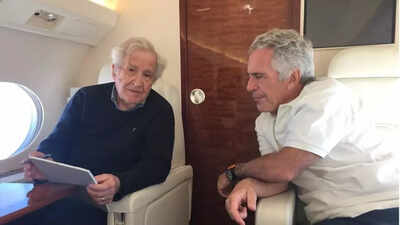
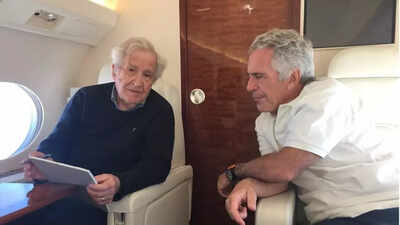
Emails exchanged in November and December 2016 show that Valeria Chomsky asked Jeffrey Epstein to help arrange a meeting between her husband, Noam Chomsky, and Donald Trump, shortly after Trump’s election victory. In the same correspondence, Valeria Chomsky also expressed interest in a political role inside the Trump White House.
November 13, 2016: Post-election exchanges
On November 13, 2016, days after Trump won the presidential election, Epstein emailed Valeria Chomsky with the message: “we called it”.
Valeria Chomsky repliedaffirmatively. In a subsequent email the same day, she wrote that she had anticipated Trump’s rise even before the primaries and had said so publicly in meetings, lunches and dinners, but had been met with disbelief.Earlier that day, Valeria Chomsky reminded Epstein that he had previously asked whom she would like Noam Chomsky to speak with. Referring to Trump, she wrote: “Here is a guy! Can you arrange it? He could make good use of Noam’s advices.”
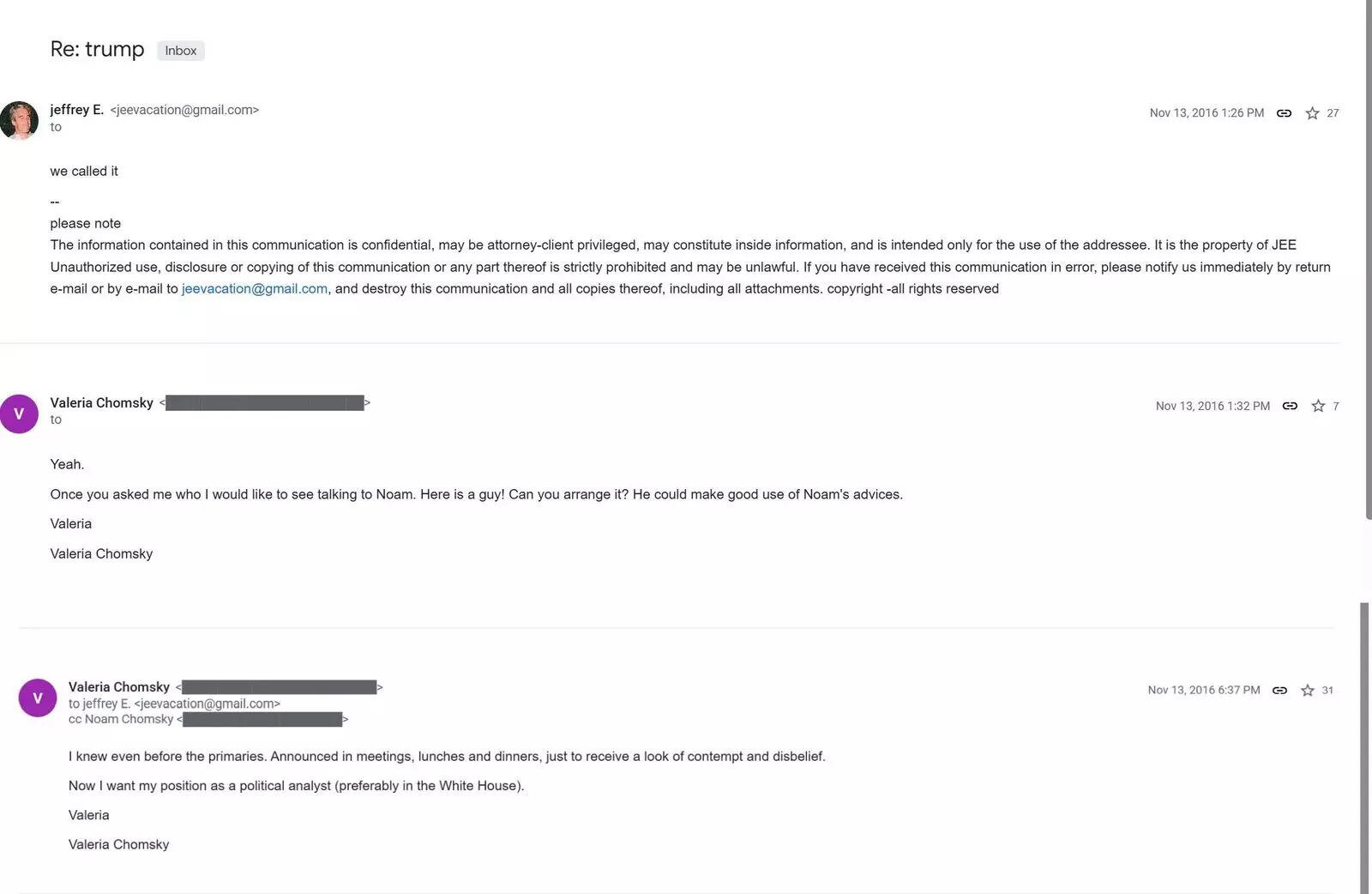
Later on November 13, Valeria Chomsky sent another email to Epstein, copying Noam Chomsky. In that message, she wrote: “Now I want my position as a political analyst (preferably in the White House).”
December 26, 2016: Trump discussed between Epstein and Noam Chomsky
On December 26, 2016, Epstein emailed Noam Chomsky after an earlier academic exchange and introduced Trump into the conversation. Epstein wrote that “one of Donald’s closest people” had said Trump had written three books, “which makes him one of the few people in the world that has written more books than he has read”.Noam Chomsky replied that he had read what Trump’s ghostwriter had said about him, calling it “pretty scary”. In the same message, Chomsky referred to Trump’s tweets and wrote that, regardless of Trump’s own thinking, others at home and abroad would assign meaning to his words and act on them.Valeria Chomsky was copied on this exchange.The emails form part of a vast new tranche of Epstein files released by the US Department of Justice in early 2026 following sustained bipartisan pressure for transparency. The disclosure runs into millions of pages of internal emails, investigative notes, court filings, and correspondence drawn from federal probes spanning more than two decades, including the Florida investigation that led to Epstein’s controversial 2008 plea deal and the later New York sex-trafficking case that was cut short by his death in custody in 2019. The release was mandated by Congress after years of criticism that prosecutors concealed key information from Epstein’s victims and shielded powerful individuals who remained in his orbit even after his conviction for soliciting a minor.Unlike earlier, more limited disclosures, this tranche sheds light on how Epstein continued to operate socially and politically long after his crimes were publicly known. The records show him cultivating relationships across ideological lines, positioning himself as a fixer who could broker introductions, offer advice, and connect academics, politicians, financiers, and media figures behind the scenes. While the documents do not allege criminal conduct by many of those named, they reveal the extent to which Epstein retained access, credibility, and influence within elite circles well into the late 2010s.It is within this broader context that the Chomsky emails have attracted renewed scrutiny. They illustrate how Epstein was treated as a conduit to political power during a moment of upheaval following Donald Trump’s unexpected election victory, and how discussions about access to the president-elect and potential roles within his administration were taking place privately, mediated by Epstein, within days of the vote.