

‘National Total War’: America’s Growing Vulnerability Amid China’s Military Ascent | World News
For the first time, a Pentagon report says plainly what had long been implied. China’s “historic military buildup” has made the US homeland “increasingly vulnerable.” The phrase appears early in the Defense Department’s 2025 annual assessment of China’s military power, and it is not rhetorical flourish. It marks a shift in how the US government wants Americans to understand the problem Beijing poses. This is no longer only about aircraft carriers in the Pacific or missile ranges around Taiwan. It is about the United States itself as a target.The report, formally titled Military and Security Developments Involving the People’s Republic of China, describes a Chinese military that is no longer content with regional deterrence. The People’s Liberation Army is now measuring its capabilities against what it calls the “strong enemy,” an unmistakable reference to the United States. In doing so, it is building ways to pressure American decision-making directly, including through cyber access to critical infrastructure, long-range conventional and nuclear strikes, and attacks on the space systems that underpin US military power.The effect, the report argues, is a new vulnerability equation. Washington must now think not only about whether it can intervene in a conflict near Taiwan, but whether it can do so while absorbing disruption at home.Why it matters
- The Pentagon’s core point isn’t just that China is getting stronger. It’s that Beijing is building multiple ways to shape US decision-making in a crisis-by threatening the homeland directly while also complicating US military intervention in the Indo-Pacific.
- That shift widens the problem from “Can the US win near Taiwan?” to “Can the US sustain domestic stability, critical infrastructure, and space-enabled warfighting while intervening?” The report’s framing of vulnerability is deliberately multi-domain. The latest benchmark: 2027
- The report says the PLA is making “steady progress” toward its 2027 goals, including achieving “strategic decisive victory” over Taiwan and building “strategic counterbalance” against the US in nuclear and other strategic domains. Then it translates the implication plainly: “China expects to be able to fight and win a war on Taiwan by the end of 2027.”
- To get there, the report says the PLA is refining options to force unification, including “most dangerously” an amphibious invasion, “firepower strike,” and possibly a maritime blockade-testing “essential components” through 2024 exercises, including striking sea/land targets and striking US forces in the Pacific.
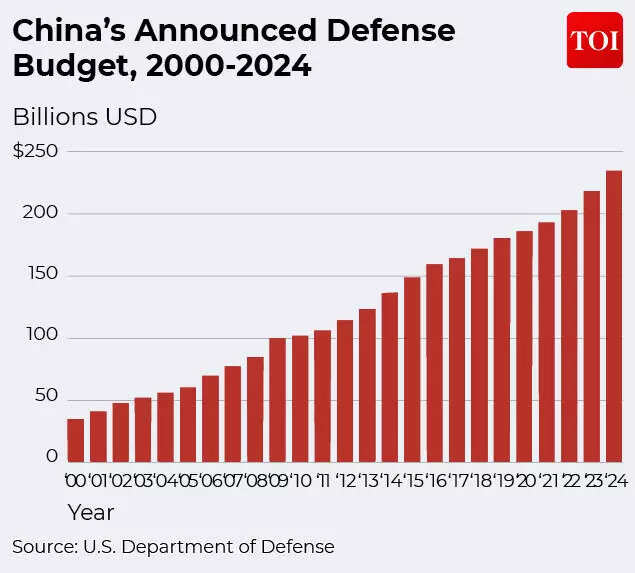
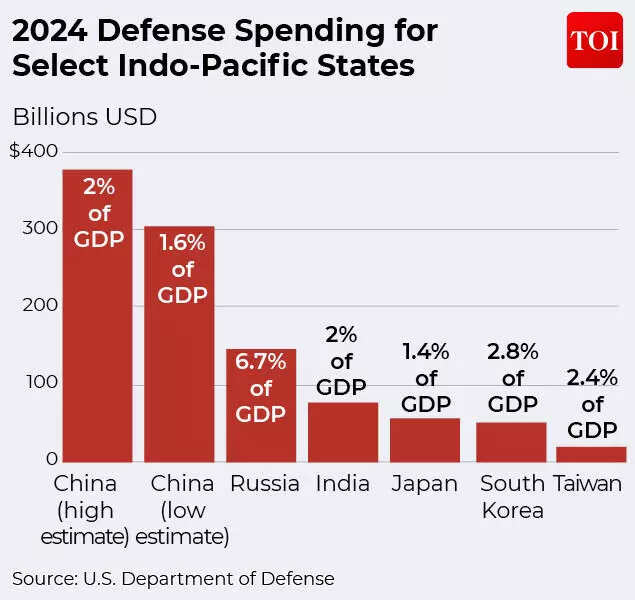
‘National total war’The most striking doctrinal shift described in the report is Beijing’s embrace of what Chinese military writings call “national total war.” The idea treats future conflict not as a discrete military contest but as a clash between entire national systems. Political authority, economic resilience, civilian infrastructure, information control, and military power are all part of the same battlefield.The Pentagon links this thinking directly to China’s long-term political goal of “national rejuvenation” by 2049 and to its nearer-term military benchmarks. Defense spending has nearly doubled since Xi Jinping took power. Civil-military integration reforms are designed to ensure that commercial sectors and local governments can be rapidly mobilized in wartime. Chinese planners, the report notes, have studied the war in Ukraine closely, drawing lessons about industrial capacity, sanctions resistance, and the risks of a prolonged fight.
This is not abstract theory. The report repeatedly emphasizes integration. China’s “core operational concept,” known as Multi-Domain Precision Warfare, is built around fusing data from space, cyber, air, sea, and land sensors into a single targeting system. The aim is to identify weak points in an adversary’s operational system and strike them quickly, at scale, and in coordination.
Taiwan as the pacing scenarioEverything in the report ultimately bends back toward Taiwan. The Pentagon reiterates that the PLA is making “steady progress” toward its 2027 goals, which are explicitly tied to the ability to force unification with the island. The assessment translates the implication without hedging: China expects to be able to “fight and win” a war over Taiwan by the end of 2027.To get there, Beijing is refining multiple military options. A maritime blockade. A joint firepower strike campaign. A full-scale amphibious invasion. In 2024, the PLA’s “JOINT SWORD” exercises rehearsed the encirclement of the island, simulated strikes on sea and land targets, and practiced blocking key ports. These were not symbolic displays. They were stress tests of command-and-control, logistics, and coordination under realistic conditions.Crucially, Taiwan planning is inseparable from counter-intervention. The PLA’s growing missile forces can now range 1,500 to 2,000 nautical miles from China’s shores. In sufficient volume, the report warns, those strikes could seriously disrupt US operations across the western Pacific. Chinese units train against professional “blue forces” that replicate US equipment and tactics. The point is explicit preparation for a fight with American forces, not a generic regional contingency.Cyber as a homeland leverIf Taiwan is the likely trigger, cyber operations are the lever that reaches home. The report calls China the most persistent cyber threat to US government, military, and civilian networks in 2024. What distinguishes the current assessment is its emphasis on pre-positioning.Chinese cyber actors associated with campaigns such as “Volt Typhoon” have “burrowed into US critical infrastructure,” the report says. These intrusions go beyond espionage. They demonstrate the ability to disrupt systems during a crisis, including those needed to mobilize and deploy US forces. Likely targets include military command networks and civilian infrastructure with political or economic significance.The Pentagon’s language is careful but unsettling. Disruptions might be localized and temporary, lasting days or weeks. But the strategic effect could be outsized. Interruptions to pipelines, power, or telecommunications during a Taiwan crisis could slow military response and generate public pressure at home. Another campaign, known as “Salt Typhoon,” targeted US telecommunications providers in 2024, highlighting vulnerabilities in the backbone of American communications.Taken together, cyber operations are portrayed as a way to impose costs below the nuclear threshold while shaping the domestic environment in which US leaders make decisions.The ‘kill chain’The report is equally blunt about space. China sees space superiority as decisive. Its intelligence, surveillance, and reconnaissance satellite fleet has more than tripled since 2018, reaching over 359 systems by early 2024. That constellation dramatically improves China’s ability to track US aircraft carriers and expeditionary forces across the Pacific.These satellites are not passive observers. They are integral to closing what the military calls the kill chain: finding targets, tracking them, and delivering long-range precision strikes. Without space-based sensors and communications, that chain breaks.China is therefore building multiple ways to sever its adversary’s access to space. The report describes kinetic antisatellite missiles capable of destroying satellites in low Earth orbit, with ambitions to reach higher orbits. It highlights “dual-use” satellites equipped with robotic arms, such as Shijian-21, that can grapple and reposition other satellites. Ground-based lasers can disrupt or damage sensors. Jammers target military satellite communications across frequency bands.Cyber plays a role here too. Chinese actors have been implicated in attacks on foreign satellite networks, particularly those of the United States. The goal is not necessarily to destroy everything, but to degrade enough systems to slow decision-making and blunt operational advantage at the outset of a conflict.Nuclear growth and signalingOverlaying all of this is a rapidly expanding nuclear force. China’s warhead stockpile remained in the low 600s through 2024, the report says, but it is on track to exceed 1,000 by 2030. New silo fields in western China, a growing fleet of mobile intercontinental ballistic missiles, and advances in early warning systems point to a shift toward higher readiness.The report also notes Chinese interest in lower-yield nuclear weapons, suggesting a strategy that contemplates limited nuclear use rather than only massive retaliation.The effect is to thicken the strategic layer. Nuclear expansion does not replace cyber or conventional pressure. It sits alongside them, complicating escalation dynamics and shortening decision timelines.Ships, reach, and presenceNaval power provides the endurance behind this posture. China’s third aircraft carrier, Fujian, completed its first sea trials in 2024. The navy aims to field six carriers by 2035, for a total of nine. In October, China’s two operational carriers conducted their first dual-carrier operations, a milestone in integrated combat capability.The relevance to homeland vulnerability is indirect but real. Maritime power supports blockade options around Taiwan and sustained airpower projection. It also helps keep US forces at distance while other tools apply pressure elsewhere.China’s ambitions are not confined to the Indo-Pacific. The report details a growing global logistics network, from Djibouti to Cambodia’s Ream Naval Base, with potential future sites in Africa and the Pacific islands. Access to the Atlantic, the Pentagon warns, would pose new challenges for US planners.
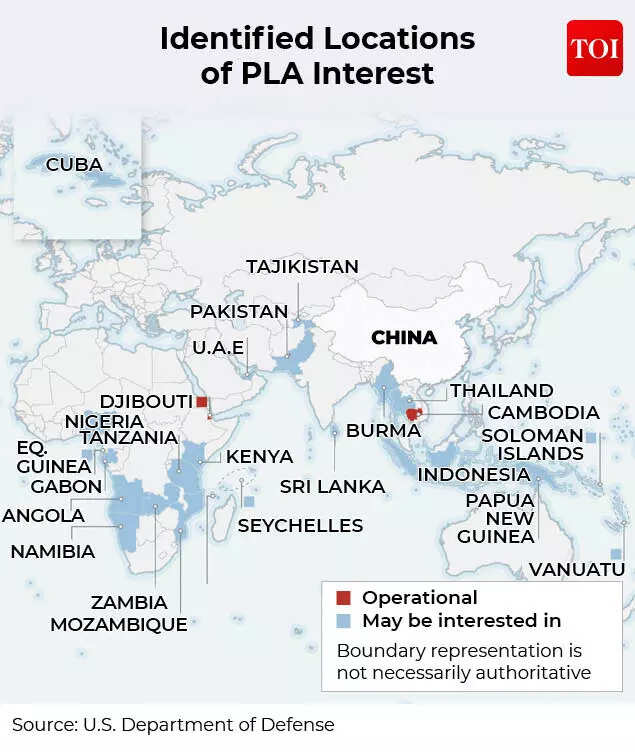
Russia and the outer perimeterChina’s partnership with Russia adds another layer. Combined bomber patrols near Alaska, joint coast guard operations in the Bering Sea, and expanded exercises signal a shared interest in countering the United States. These activities are not decisive on their own, but they stretch attention and resources, reinforcing the report’s central theme of multi-directional pressure.What the warning really meansThe Pentagon’s core message is not simply that China is stronger. It is that Beijing is building an integrated system designed to shape US choices in a crisis. The question is no longer only whether the United States can prevail militarily near Taiwan. It is whether it can do so while managing cyber disruption at home, threats to space systems, and a more complex nuclear backdrop.China is not betting on a single knockout blow. It is constructing multiple pressure points, many of them far from the Taiwan Strait, to raise the cost and uncertainty of American intervention.The report does not offer easy solutions. It does, however, make clear that the era in which the US homeland could be treated as a sanctuary in great-power conflict is ending. The competition, as Beijing’s own doctrine suggests, is becoming a contest between entire systems. And in that contest, distance alone is no longer protection.