
Post Operation Sindoor push: Defence budget jumps 15% to Rs 7.85 lakh crore; what’s in the pipeline for India’s military
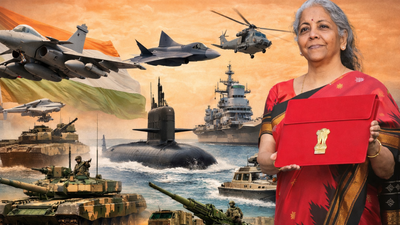
NEW DELHI: The Union Budget 2026 has set aside Rs 7.85 lakh crore for defence, marking a sharp 15 per cent jump from Rs 6.81 lakh crore last year, as the government sharpens its focus on military modernisation in the post Operation Sindoor security environment.According to official figures, the defence outlay for 2026–27 stands at Rs 7,84,678 crore, compared with Rs 6,81,210 crore in the previous financial year. Of this, the capital outlay has been pegged at Rs 2,19,306 crore, while revenue expenditure stands at Rs 5,53,668 crore, including Rs 1,71,338 crore for pensions.
The armed forces will receive Rs 2.19 lakh crore for modernisation, with allocations including Rs 63,733 crore for aircraft and aero engines and Rs 25,023 crore for the naval fleet. The defence ministry has several major projects in the pipeline, including contracts for fighter jets, submarines, unmanned systems and helicopters.In comparison, the capital outlay in 2025–26 was pegged at Rs 1,80,000 crore, later raised to Rs 1,86,454 crore at the revised estimate stage. In her budget speech, finance minister Nirmala Sitharaman proposed exempting basic customs duty on components and parts required for the manufacture of civilian, training and other aircraft. She also announced the waiver of basic customs duty on raw materials imported for the manufacture of aircraft parts used for maintenance, repair or overhaul by defence sector units, a move expected to provide a boost to the defence aerospace industry.Meanwhile, the defence services (Revenue) and Capital Outlay were allocated Rs 3,65,478.98 crore and Rs 2,19,306.47 crore, reflecting jumps of 17.24 per cent and 21.84 per cent, respectively. In a boost to the defence sector, Sitharaman announced, “It is proposed to exempt basic customs duty on raw materials imported for the manufacture of parts of aircraft to be used in maintenance, repair or overall requirements by units in the defence sector.”
What’s in the pipeline for India’s defence in 2026–27
Rafale jets and Su-57: Two parallel paths for India’s future fighter fleet
India’s fighter aircraft pipeline for 2026–27 is being shaped by two parallel and strategically distinct tracks: a large-scale expansion of the Rafale fleet through indigenous manufacturing, and renewed technical talks with Russia on the fifth-generation Su-57, even as New Delhi keeps its long-term focus on homegrown programmes.On the western front, the defence ministry is preparing to take up a Rs 3.25 lakh crore proposal to acquire 114 Rafale fighter jets from France, a deal that would become India’s largest-ever defence procurement if cleared. Under the proposal, most of the aircraft would be manufactured in India under a government-to-government agreement, with around 30 per cent indigenous content initially, a figure officials say could rise to over 60 per cent during production. The plan also includes 12 to 18 Rafales in fly-away condition to meet the Indian Air Force’s immediate operational needs. If approved, the deal would take the total number of Rafales in Indian service to 176, including 36 already inducted by the IAF and 26 Rafale-M jets ordered for the Navy. India has also sought integration of indigenous weapons and systems on the aircraft, though source codes will remain with the French side. The push comes amid reports that Rafales performed effectively during Operation Sindoor, particularly against advanced Chinese air-to-air missiles using the Spectra electronic warfare suite. France is also planning a maintenance, repair and overhaul facility for Rafale M-88 engines in Hyderabad, with Indian private sector participation.
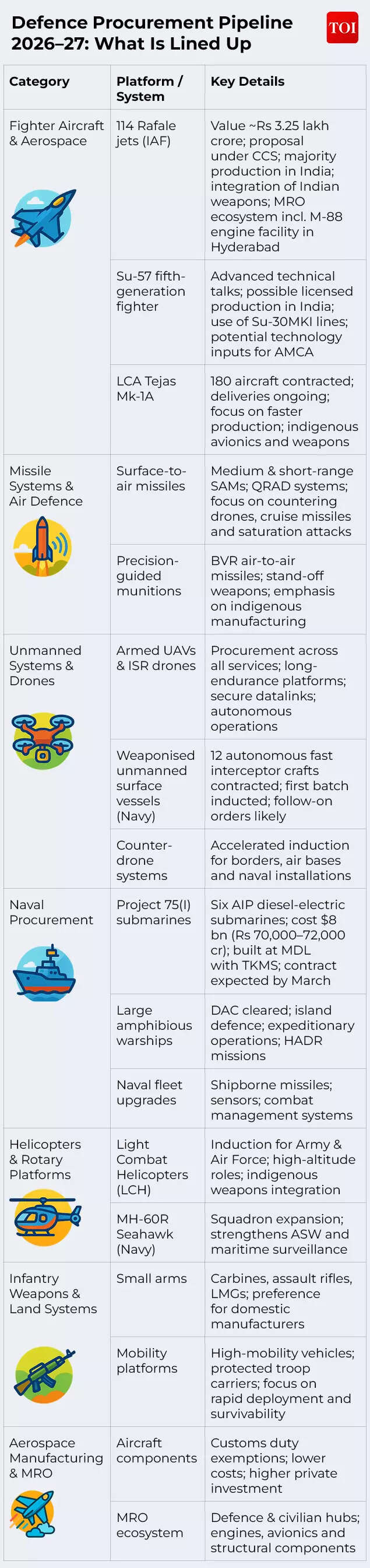
Running in parallel is Russia’s renewed pitch for the Su-57, its fifth-generation stealth fighter, after years of dormancy following India’s exit from the earlier FGFA programme. Senior Russian aerospace officials have said that technical consultations with India are at an advanced stage, including discussions on licensed production of the export variant Su-57E in India at facilities currently manufacturing the Su-30MKI. According to United Aircraft Corporation CEO Vadim Badekha, the talks also cover maximum use of Indian industry and Indian systems, signalling Moscow’s attempt to re-enter India’s fighter ecosystem as New Delhi evaluates multiple options for future air combat capability. Russia has also offered assistance in India’s indigenous AMCA programme, positioning the Su-57 as both a near-term capability and a technology bridge.Also read: Russia–India talks on Su-57: what is on the table, and what the fighter really offersDespite offers from both Russia and the United States, including the F-35, India continues to prioritise the Rafale for near-term induction while keeping discussions on fifth-generation platforms open. Officials indicate that the Indian Air Force’s future fighter fleet will likely rest on a mix of Su-30MKI upgrades, an expanded Rafale fleet, large-scale induction of LCA Mk1A, and the indigenous AMCA beyond 2035, with the 2026–27 budget cycle marking a decisive phase in shaping that trajectory. Also read: Rs 3.25 lakh crore Rafale deal: Defence ministry to take up 114-jet proposal – all you need to know
Submarine development and Project 75(I): India’s $8 billion undersea capability leap
Project 75(I) is emerging as one of India’s most consequential defence programmes for 2026–27, with India and Germany close to signing an estimated $8 billion (around Rs 70,000–72,000 crore) deal to build six next-generation conventional submarines for the Indian Navy. Negotiations have reached an advanced stage and the pact is expected to be finalised by March-end, making it India’s largest-ever defence contract, surpassing even the 2016 Rafale deal.The long-delayed Project 75(I) is designed to address the rapid ageing of India’s conventional submarine fleet and to strengthen maritime deterrence at a time when China and Pakistan are expanding their undersea presence in the Indian Ocean Region. The programme focuses on diesel-electric attack submarines fitted with fuel-cell-based air-independent propulsion (AIP), a capability that allows submarines to remain submerged for weeks rather than days, drastically reducing detection risks.Under the proposed arrangement, Germany’s ThyssenKrupp Marine Systems (TKMS) will partner with Mazagon Dock Shipbuilders Ltd (MDL) to build all six submarines in India under the Strategic Partnership model. The selected platform is the German Type-214 Next Generation submarine, which edged out Spain’s S-80 Plus primarily due to the maturity and operational reliability of its AIP technology, acoustic stealth and lower lifecycle risk. Indigenous content is expected to begin at 45 per cent and rise to nearly 60 per cent by the final boat, in line with the government’s Make in India and Atmanirbhar Bharat goals.Also read – India, Germany close to signing $8 bn P75I submarine deal, pact likely by March-endThe programme, approved by the defence acquisition council in 2014 and formally tendered through an RFP in July 2021, also envisages deep technology transfer, long-term industrial collaboration and the creation of a domestic submarine-building ecosystem. Beyond shipyards, the project is expected to benefit MSMEs through manufacturing of spares, sensors, combat systems and associated equipment, giving a sustained boost to India’s naval industrial base.
For the Indian Navy, Project 75(I) is a critical capability upgrade. India currently operates around a dozen Russian-origin submarines and six French-built Scorpène-class boats, even as undersea activity by China’s PLA Navy and Pakistan’s Navy intensifies across the Indo-Pacific. The induction of six advanced AIP-equipped submarines is expected to significantly enhance sea denial, surveillance and deterrence, reshaping the regional balance under the waterline.Also read: Project-75I: How India’s $8 billion submarine upgrade reshapes the Pakistan, China equationThe push behind Project 75(I) also aligns with India’s broader naval indigenisation drive. Under the Indian Naval Indigenisation Plan 2015–2030, 51 large vessels worth nearly Rs 90,000 crore are already under construction in Indian shipyards, with over 40 indigenous warships and submarines delivered since 2014. Against this backdrop, Project 75(I) stands out as the centrepiece of India’s undersea warfare roadmap for the coming decade.
Naval unmanned platforms and coastal security: India’s leap into autonomous maritime warfare
India’s coastal and near-sea security architecture is set for a major upgrade in 2026–27 with the induction of the country’s first autonomous weaponised unmanned fast interceptor crafts (FICs) into the Indian Navy, marking a decisive shift towards network-centric and unmanned maritime operations.The Navy is preparing to deploy the first batch of two weaponised unmanned interceptor crafts, developed and manufactured entirely in India by Pune-based Sagar defence Engineering, with deployment planned along the western seaboard, according to official sources. The induction will place India in a select global club of nations capable of developing and operating weaponised unmanned vessel swarms, a capability that has so far been limited to a handful of advanced naval powers.The Navy had placed an order for 12 such interceptor crafts under a contract signed on January 5, 2022, as part of the iDEX–defence Innovation Organisation framework, aimed at promoting indigenous defence technologies. Until now, the Navy has relied largely on Israel-made unmanned surface vessels, primarily restricted to mine counter-measure roles, making the FIC programme a major expansion in scope and capability.The unmanned interceptor craft is equipped with a 12.7 mm gun for close-range engagements and has the capability to deploy short-range missiles and loitering munitions, allowing it to counter asymmetric maritime threats, fast attack boats and hostile surface targets. A key operational advantage lies in its swarm capability, where multiple crafts can be controlled from a single command-and-control station, enabling force multiplication while significantly reducing risk to human operators.One of the most critical features of the platform is its ability to operate in a GPS-denied and electronic warfare environment. Advanced navigation and control systems allow the craft to continue missions even when satellite signals are disrupted, ensuring resilience during high-intensity conflict scenarios. With an endurance of over 48 hours at sea, the craft provides sustained surveillance and patrol capability, strengthening maritime domain awareness along India’s extensive coastline.Despite being unmanned, the interceptor craft retains operational flexibility, with the ability to carry more than 14 personnel for specific missions, including special operations, rapid insertion, evacuation or boarding tasks. Its layered weapons architecture and operational range of over 400 nautical miles, or roughly 800 km, make it suitable for extended patrols, coastal defence and quick-response roles in sensitive maritime zones.The induction of these autonomous interceptor crafts aligns with India’s broader push towards self-reliance in defence manufacturing and reflects a strategic pivot towards autonomous, networked and unmanned warfare, an area increasingly shaping modern naval doctrine. As the Navy expands its unmanned surface fleet in the coming years, such platforms are expected to play a central role in securing India’s coastline, ports and offshore assets while redefining maritime operations in the Indian Ocean region.Also read – India set to enter select club as Navy readies to get delivery of weaponised unmanned intercept craft
Capital outlay fuels modernisation, indigenisation across air, land and sea
The Union Budget 2026 sharpens India’s defence modernisation push, with higher capital outlay directed towards missiles, UAVs, next-generation drones, advanced radars, air defence systems and network-centric warfare capabilities. Customs duty exemptions on aircraft components and raw materials for maintenance, repair and overhaul are expected to lower costs, attract private investment and deepen the domestic aerospace ecosystem under Make in India. Since January 2025, the Defence Acquisition Council has approved capital acquisitions worth over Rs 3.84 lakh crore, spanning missiles, electronic warfare systems, drones, artillery, armoured vehicles and air defence platforms across all three services.
Naval expansion, helicopters and frontline systems get major boost
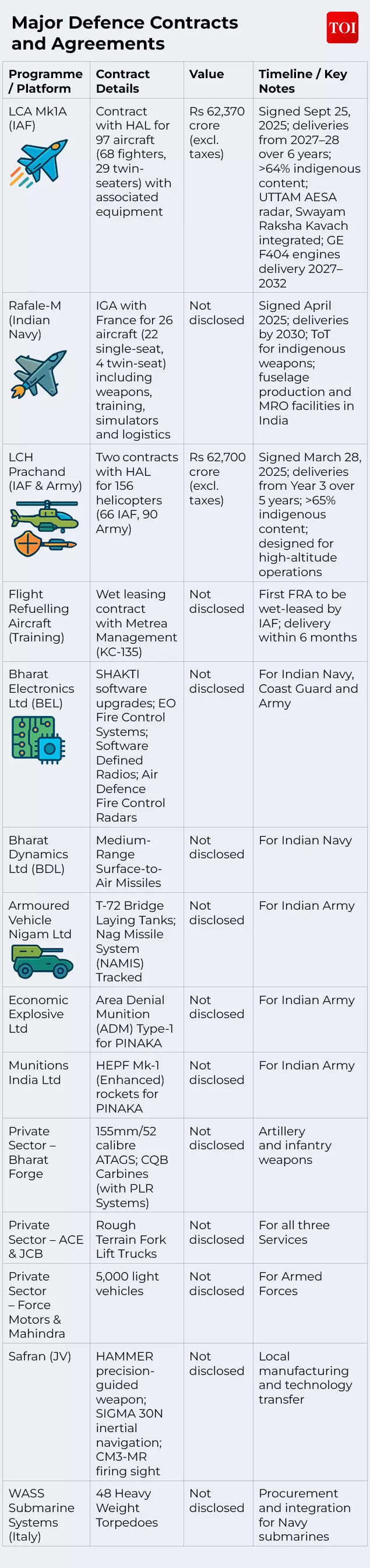
India’s maritime and expeditionary capabilities are set to expand after the DAC cleared procurement proposals worth around Rs 79,000 crore, including large amphibious warships, landing platform docks, naval guns and support vessels, alongside anti-tank missiles, high-mobility vehicles and long-range drones. The modernisation roadmap also prioritises 156 Light Combat Helicopters (LCH) Prachand for the Army and Air Force, designed for high-altitude operations with over 65% indigenous content, as well as expanded induction of armed drones, surveillance UAVs and counter-drone systems. Smaller but critical deals, including 4.25 lakh carbines for the Army and 48 heavyweight Black Shark torpedoes for the Navy, are aimed at closing frontline capability gaps.
Indigenous aerospace, missiles and manufacturing ecosystem gathers momentum
India’s long-term air combat plans remain anchored in indigenous programmes led by the LCA Tejas Mk1A and the Advanced Medium Combat Aircraft (AMCA). Contracts for 97 additional LCA Mk1A jets, featuring over 64% indigenous content, are in place with deliveries from 2027–28, while the AMCA execution model has opened development to both public and private Indian firms. HAL has expanded production capacity by operationalising a third LCA Mk1A line and a second HTT-40 trainer line, raising Tejas output to 24 aircraft annually. Parallelly, ammunition self-reliance has accelerated, with 32 variants worth Rs 15,899 crore offered for long-term domestic production, most expected to be indigenised by 2027–28. The BrahMos Integration and Testing Facility in Lucknow has begun missile dispatches, reinforcing India’s end-to-end missile manufacturing capability. Overall, 193 defence contracts worth over Rs 2.09 lakh crore were signed in 2024–25, with 92% awarded to domestic industry, marking a decisive shift towards a robust public-private defence manufacturing ecosystem.